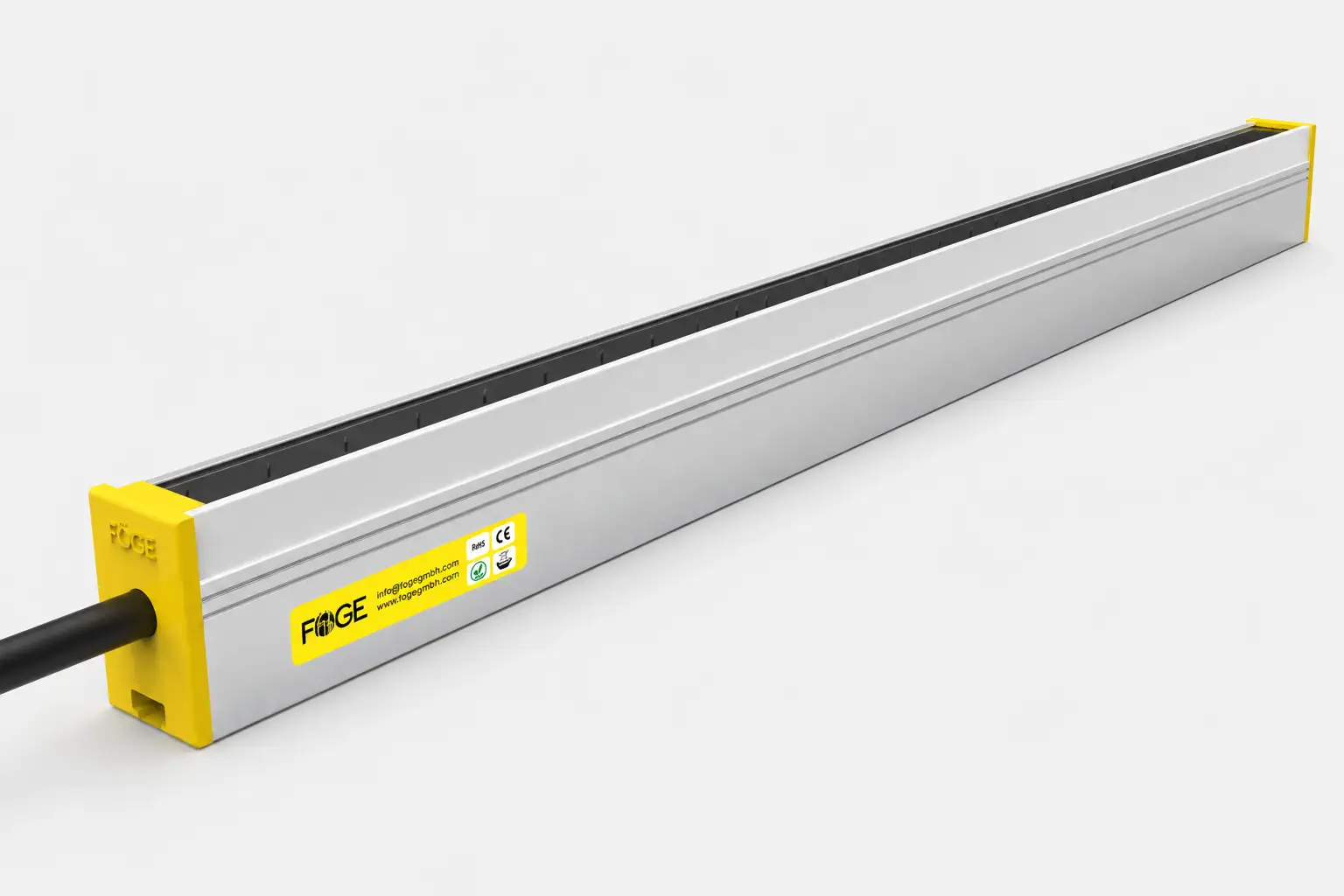
SE-DCN Pulsed DC Nozzle Antistatic Bar

Simultaneous pulsed DC static elimination and high-velocity air blast — dust removal, surface cleaning, sheet separation and mould release with 24V DC simplicity

Product Description

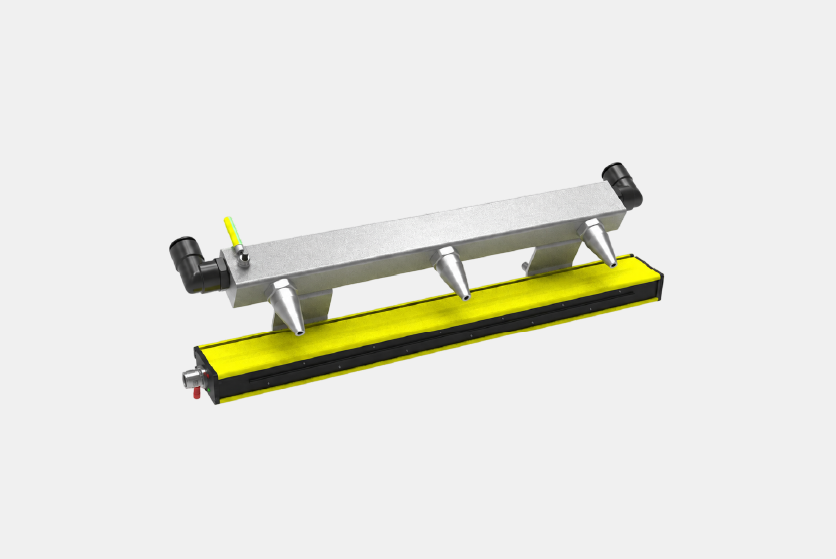
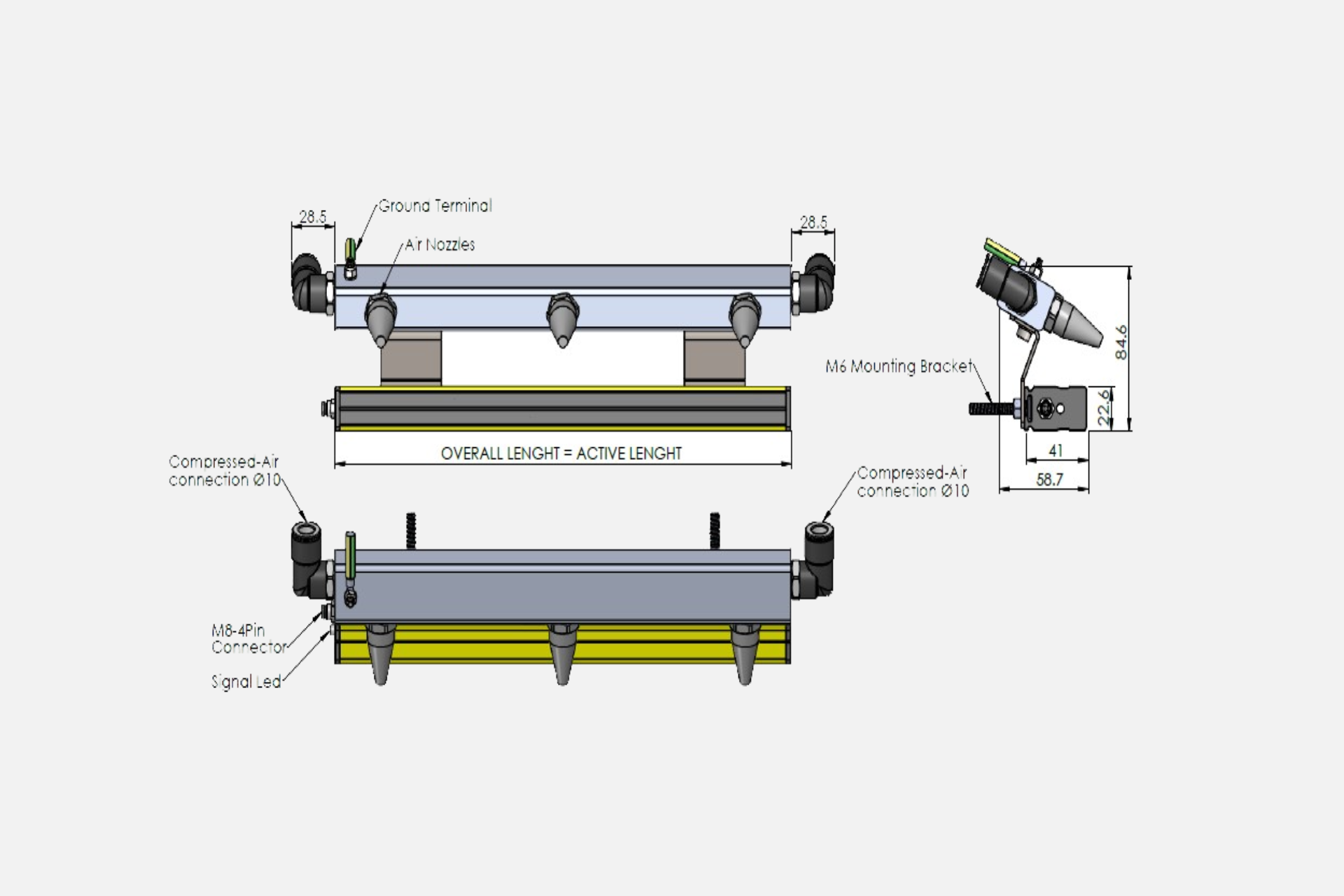
The FÖGE SE-DCN is a pulsed DC nozzle antistatic bar that combines the ionisation technology of the SE-DCL pulsed DC ioniser with the high-velocity air nozzle delivery system of the SE-ACN bar. Like the SE-ACN, the SE-DCN is a dual-function device: it simultaneously neutralises electrostatic charge on the target surface and delivers a powerful focused air blast from a row of nozzles along the bar body — either to blow away dust, particles and contamination from that surface, or to provide the mechanical air force needed to separate parts that are stuck together by static. The difference from the SE-ACN is the ionisation technology: the SE-DCN uses pulsed DC ionisation from a 24V DC supply rather than AC ionisation from an SE-PAC high-voltage power unit. This 24V DC operating basis is the key practical advantage of the SE-DCN over the SE-ACN. No HV transformer, no HV cabling and no SE-PAC power unit are required — the SE-DCN simply connects to a standard 24V DC supply (SE-PSU-24-C-M12, sold separately) via an M12 5-pin industrial connector. This makes it straightforward to integrate into machine control systems, robotic installations and any production line that already operates on a 24V DC infrastructure. The pulsed DC alternating ionisation delivers a balanced mix of positive and negative ions, ensuring complete charge neutralisation regardless of the polarity of the static present. A compressed air supply is required at the installation point to operate the nozzle air jets.

Industries

Printing (offset, digital, flexo — sheet separation, pre-print cleaning)
Plastics & Injection Moulding (mould release, part cleaning)
Packaging (sheet feeders, thermoforming, blister packing)
Electronics & PCB Manufacturing (component cleaning, assembly preparation)
Film & Flexible Packaging (web cleaning, dust removal before coating)
Paper & Board (sheet separation, web cleaning)
Automotive (plastic panel cleaning before paint)
Robotics & Industrial Automation (machine integration with 24V DC control systems)
Dual function: pulsed DC ionisation + high-velocity air jets — neutralise static AND clean, separate or release simultaneously
SE-DCL pulsed DC ionisation technology — same ionisation system as SE-DCL
24V DC supply — no HV power unit (SE-PAC) required — simpler installation than SE-ACN
M12, 5-pin industrial connector — standard 24V DC infrastructure, same as SE-DCB and SE-DCA bars
High-velocity focused nozzle air jets — removes dust and contamination or separates static-stuck parts
Alternating pulsed DC — balanced positive and negative ion output for complete charge neutralisation
Shockless operation — safe for operators
Industrial-grade housing
Compressed air required at installation point
Product Description

The FÖGE SE-DCN is a pulsed DC nozzle antistatic bar that combines the ionisation technology of the SE-DCL pulsed DC ioniser with the high-velocity air nozzle delivery system of the SE-ACN bar. Like the SE-ACN, the SE-DCN is a dual-function device: it simultaneously neutralises electrostatic charge on the target surface and delivers a powerful focused air blast from a row of nozzles along the bar body — either to blow away dust, particles and contamination from that surface, or to provide the mechanical air force needed to separate parts that are stuck together by static. The difference from the SE-ACN is the ionisation technology: the SE-DCN uses pulsed DC ionisation from a 24V DC supply rather than AC ionisation from an SE-PAC high-voltage power unit. This 24V DC operating basis is the key practical advantage of the SE-DCN over the SE-ACN. No HV transformer, no HV cabling and no SE-PAC power unit are required — the SE-DCN simply connects to a standard 24V DC supply (SE-PSU-24-C-M12, sold separately) via an M12 5-pin industrial connector. This makes it straightforward to integrate into machine control systems, robotic installations and any production line that already operates on a 24V DC infrastructure. The pulsed DC alternating ionisation delivers a balanced mix of positive and negative ions, ensuring complete charge neutralisation regardless of the polarity of the static present. A compressed air supply is required at the installation point to operate the nozzle air jets.

Industries

Printing (offset, digital, flexo — sheet separation, pre-print cleaning)
Plastics & Injection Moulding (mould release, part cleaning)
Packaging (sheet feeders, thermoforming, blister packing)
Electronics & PCB Manufacturing (component cleaning, assembly preparation)
Film & Flexible Packaging (web cleaning, dust removal before coating)
Paper & Board (sheet separation, web cleaning)
Automotive (plastic panel cleaning before paint)
Robotics & Industrial Automation (machine integration with 24V DC control systems)
Dual function: pulsed DC ionisation + high-velocity air jets — neutralise static AND clean, separate or release simultaneously
SE-DCL pulsed DC ionisation technology — same ionisation system as SE-DCL
24V DC supply — no HV power unit (SE-PAC) required — simpler installation than SE-ACN
M12, 5-pin industrial connector — standard 24V DC infrastructure, same as SE-DCB and SE-DCA bars
High-velocity focused nozzle air jets — removes dust and contamination or separates static-stuck parts
Alternating pulsed DC — balanced positive and negative ion output for complete charge neutralisation
Shockless operation — safe for operators
Industrial-grade housing
Compressed air required at installation point

How It Works

The SE-DCN connects to a 24V DC supply via an M12 5-pin cable (SE-PSU-24-C-M12 adapter, sold separately). The SE-DCL pulsed DC ionisation circuit inside the bar converts the 24V input to high voltage, which is applied to the emitter pins. The pulsed DC circuit alternates continuously between positive and negative high-voltage pulses, generating a balanced stream of positive and negative ions — ensuring both polarities of static charge on the target surface are neutralised rapidly and completely. A compressed air supply connected to the bar's air inlet feeds high-pressure air through an internal manifold and out through focused nozzles positioned along the bar body. The ionised air and the direct nozzle jets combine at the target surface: ions neutralise the charge, and the air blast physically removes contamination or provides the separation force. Because the pulsed DC ionisation is generated internally from 24V DC, no external HV transformer or HV cabling is needed — the entire ionisation and air delivery system is contained within the bar itself plus the SE-PSU-24-C-M12 adapter.

The Two Functions of the SE-DCN

The SE-DCN is a dual-action device. Both functions happen simultaneously — the pulsed DC ionisation neutralises the static, and the nozzle air jet provides the physical effect. The two functions are identical to those of the SE-ACN:

01

Function A — Ionise + Clean (Dust Removal & Surface Cleaning)

Static charge holds dust, fibres, paper particles and other contamination tightly to surfaces. The SE-DCN neutralises this charge — releasing the contamination — and immediately blasts it away with high-velocity focused air from the nozzles. The result is a clean, static-free surface ready for printing, coating, laminating, bonding or inspection. Typical positions: immediately before a print head, coating unit, laminating station or optical inspection point.

02

Function B — Ionise + Separate (Part Separation & Mould Release)

Static electricity causes plastic parts to stick to injection moulds during ejection, and causes sheets to cling together in press feeders, sheet-fed machines and packaging lines. The SE-DCN neutralises the static holding the parts or sheets together, and simultaneously delivers the air blast that provides the mechanical separation force — ejecting the part from the mould cleanly or lifting the top sheet from the stack. Typical positions: injection mould exits, sheet feeder inlets, press feeders, thermoforming exits.

DCN

Key Features

Dual function: pulsed DC ionisation + high-velocity air jets — neutralise static AND clean, separate or release simultaneously
SE-DCL pulsed DC ionisation technology — same ionisation system as SE-DCL
24V DC supply — no HV power unit (SE-PAC) required — simpler installation than SE-ACN
M12, 5-pin industrial connector — standard 24V DC infrastructure, same as SE-DCB and SE-DCA bars
High-velocity focused nozzle air jets — removes dust and contamination or separates static-stuck parts
Alternating pulsed DC — balanced positive and negative ion output for complete charge neutralisation
Shockless operation — safe for operators
Industrial-grade housing
Compressed air required at installation point

SE-DCN or SE-ACN — Which Nozzle Bar to Choose?

The SE-DCN and SE-ACN perform identical dual functions (ionise + clean / ionise + separate) and use the same nozzle air delivery system. The difference is the ionisation technology and power infrastructure. Use the table to choose:
Comparison SE-DCN (this product) SE-ACN
Ionisation Technology Pulsed DC — SE-DCL-System AC — High Voltage AC
Power Supply 24 V DC (SE-PSU-24-C-M12) SE-PAC-55 (5.5kV) or SE-PAC-80 (8kV) HV unit
HV Unit Required Not required — built into bar Required — SE-PAC mains-powered HV unit
Connector M12, 5-pin — standard 24V DC HV plug-and-play connector
Voltage Variants Single variant (SE-DCL ionisation) SE-ACN-55 (5.5kV) or SE-ACN-80 (8kV)
Air Required Yes — compressed air at installation Yes — compressed air at installation
Both functions Yes — ionise + clean / ionise + separate Yes — ionise + clean / ionise + separate

Applications

Applications Where it helps
Printing Press & Sheet Feeder — Sheet Separation Neutralize the static charge between sheets while simultaneously blowing air to clear the top sheet
—reliable single-sheet feeding without double sheets.
Injection Moulding — Mould Release Neutralize freshly molded parts and assist ejection with a blast of air
— less sticking, better cycle times.
Pre-Print & Pre-Coat Surface Cleaning Remove dust, fibres and particles from paper, film, board and plastic substrates immediately before printing,
coating or varnishing. The SE-DCN neutralises the static holding contamination to the surface, then blasts it away.
Pre-Laminating & Pre-Bonding Cleaning Clean substrates before adhesive application, laminating or bonding. Static-retained contamination causes
adhesion failures, delamination and bonding defects
— the SE-DCN removes both the static and the contamination in one pass.
Thermoformed Part Separation Separate thermoformed trays, blisters and packaging components that stack and cling together due to static.
The air blast provides separation force; the ionisation removes the charge causing them to stick.
Electronic Component & PCB Cleaning Remove particulate contamination from PCBs, electronic assemblies and optical components before assembly
or inspection — without the risk of damage from contact cleaning methods.
Film & Foil Unwinding — Web Cleaning Clean and neutralise plastic film, foil and paper webs at the unwind station before converting, printing or laminating
— removing both static charge and surface particles in a single pass.

Technical Specifications

Product code Color Dimensions (mm) Power Consumption Wavelength Datasheet
VL-BAL-25-400-R-24-C30
Red
25 x 400
621nm
Download
VL-BAL-25-400-W-24-C30
White
25 x 400
6500K
Download
VL-BAL-25-400-G-24-C30
Green
25 x 400
528nm
Download
VL-BAL-25-400-B-24-C30
Blue
25 x 400
470nm
Download
VL-BAL-25-400-I-24-C30
Infrared
25 x 400
940nm
Download
VL-BAL-25-500-R-24-C30
Red
25 x 400
621nm
Download

Parameter

Specification

  1. Product code
    SE-DCN-xxxx (Please contact FÖGE for the complete order number, including length specifications)
  2. Ionization technology
    SE-DCL Pulsed DC — same ionization system as SE-DCL *
  3. Ionization output voltage
    Please confirm based on the SE-DCL data sheet *
  4. Operating Voltage
    24 V DC (21–28 V)
  5. Power adapter (sold separately)
    SE-PSU-24-C-M12 (220 V AC to 24 V DC)
  6. Connector
    M12, 5-pin industrial connector
  7. Air transmission
    High-speed air jets focused from nozzles along the rod body – identical to SE-ACN.
  8. Air Required
    Yes – at the installation point
  9. Functions
    1. Pulsed DC ionization + air jet → static elimination + dust removal / surface cleaning 2. Pulsed DC ionization + air jet → static elimination + part separation (mold release, sheet metal separation)
  10. Polarity
    Wechselndes Pulsed DC – ausgewogene positive und negative Ionenausgabe
  11. Safety
    Shockless design
  12. Housing
    Industrial quality
  13. EMC compliance
    2014/30/EU — EMC Directive *
  14. Electrical safety
    2014/35/EU — Low Voltage Directive *
  15. Ordering Length
    For available lengths, please contact FÖGE. *

Do you have any questions about this product?

Name *
Phone number *
Email *
Are you interested in several products?
Geben Sie hier die Namen weiterer Produkte ein, an denen Sie interessiert sind:
Please write down your questions about the product.

Complete System — What You Need

Components Description
SE-DCN bar (specify length) Nozzle ionising bar with SE-DCL pulsed DC ionisation — order in required length
SE-PSU-24-C-M12 power supply 220V AC to 24V DC adapter with M12 connector — required · sold separately
M12 5-pin cable Industrial M12 connection cable — length to suit installation · sold separately
Compressed air supply Clean, dry compressed air at the installation point — consult FÖGE for pressure and flow requirements
Air hose and fittings To connect the compressed air supply to the bar's air inlet
Mounting brackets (optional) Standard and custom brackets — contact FÖGE for options

Frequently Asked Questions

Both bars perform the same dual functions — ionise + clean and ionise + separate — using the same nozzle air delivery system. The difference is the ionisation technology. The SE-DCN uses pulsed DC ionisation (SE-DCL technology) from a 24V DC supply — no HV power unit required. The SE-ACN uses AC ionisation from an SE-PAC HV power unit. Choose SE-DCN when 24V DC infrastructure is available or preferred, or when no HV power unit is wanted. Choose SE-ACN when AC ionisation infrastructure is already in place.
No. The SE-DCN uses pulsed DC ionisation generated internally from 24V DC. The SE-PSU-24-C-M12 adapter (220V AC to 24V DC) is required and sold separately, but no SE-PAC HV transformer, HV cabling or HV safety zones are needed.
Yes. The SE-DCN requires a compressed air supply at the installation point to operate the nozzle air jets. Clean, dry compressed air is recommended — moisture or oil in the air supply can affect ionisation performance and contaminate the cleaned surfaces. Contact FÖGE for the recommended pressure and flow rate for your bar length and application.
Yes. The 24V DC supply and M12 5-pin connector make the SE-DCN easy to integrate into machine control cabinets and PLC-controlled systems — the same connector and supply standard used across the SE-DC product family (SE-DCB-90, SE-DCB-110, SE-DCA-110).

Related Products

Discover complementary products that boost performance and integrate seamlessly into your system.
SFM (1)

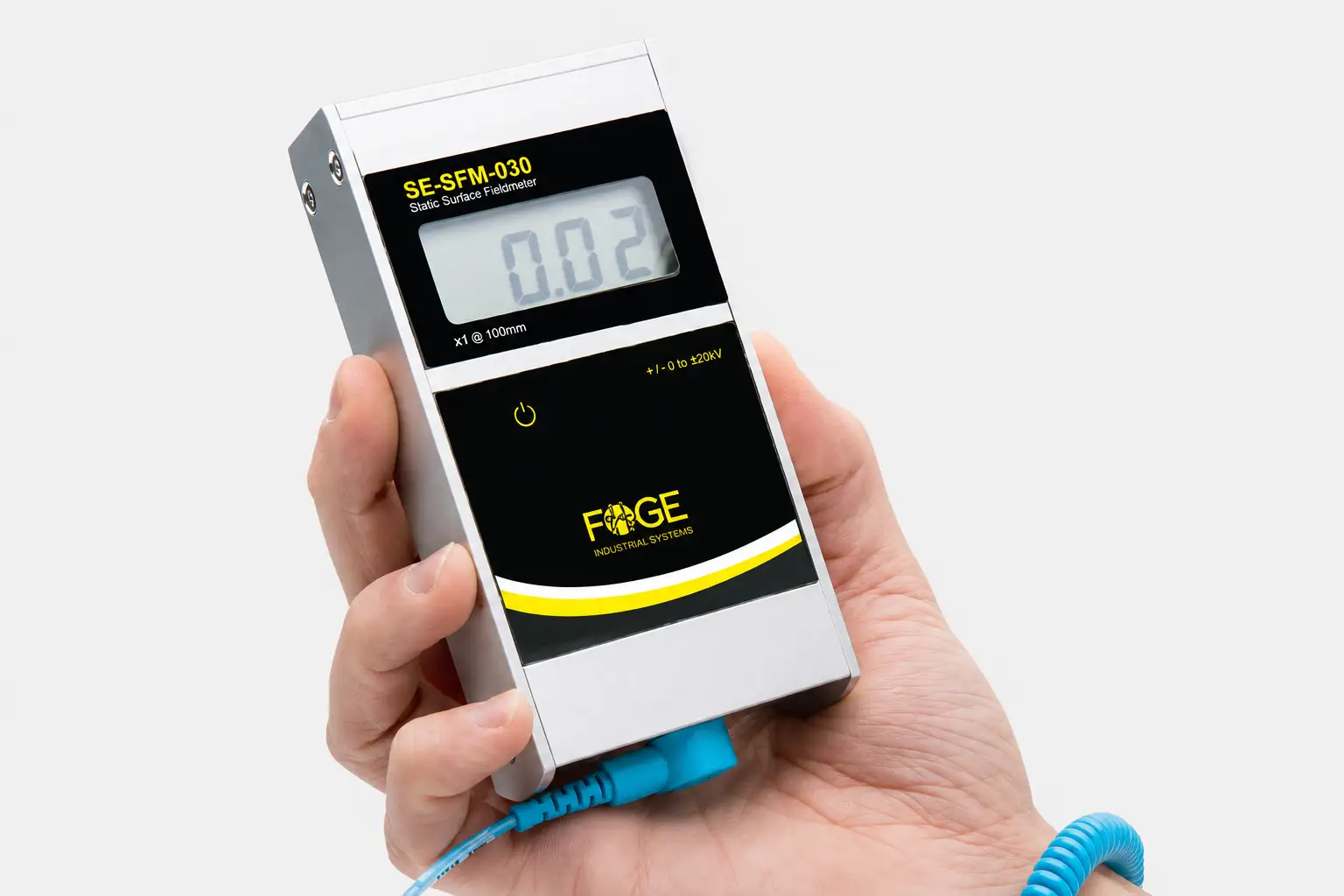
SE-SFM-030 Static Electric Fieldmeter

Handheld non-contact surface charge measurement up to 200 kV — two auto-selected ranges, polarity display, hold function
PAC (1)

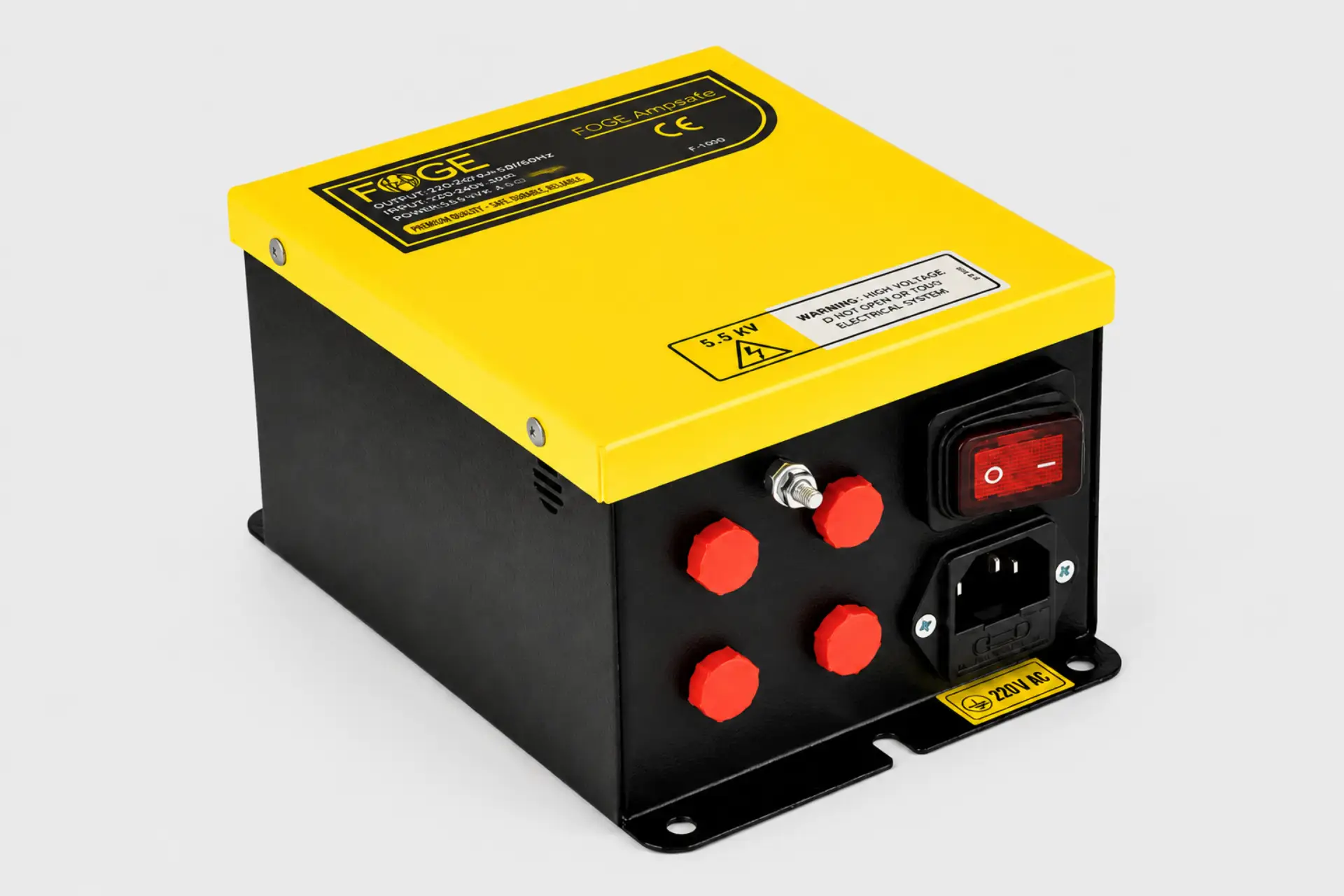
SE-PAC AC High Voltage Power Unit

Centralised 5.5 kV or 8 kV AC power for up to 4 FÖGE antistatic bars and ionisers — compact, short-circuit protected, plug-and-play

SE-DCB-90:110

SE-DCB-90 Pulsed DC Antistatic Bar — 9 kV

Compact 9 kV pulsed DC static elimination — no HV transformer, 24 V DC supply, up to 300 mm range

ACA

SE-ACA Long Range AC Antistatic Bar with Air

Air-assisted AC ionisation up to 400 mm — for 3D parts, wide-gap installations and demanding high-speed lines
ACB

SE-ACB-55 Compact AC Antistatic Bar – 5.5 kV

High-speed, compact static elimination for industrial production lines

SE-ACB-55

SE-ACB-80 High Power AC Antistatic Bar – 8 kV

Extended-range, high-speed static elimination for demanding industrial production lines